
At the start of this year, Poland became the last EU Member State in which a fiscal council (Rada Fiskalna) began operating. This symbolically completed the European jigsaw of independent fiscal oversight. In the wake of the European sovereign debt crisis, independent fiscal institutions (IFIs), such as fiscal councils, have become a standard feature of fiscal frameworks across Europe. Their role is to provide an independent assessment of the state of public finances, monitor compliance with fiscal rules and highlight long-term fiscal risks. In addition, the EU Independent Fiscal Institutions (EUIFIs) network provides a useful platform for exchanging views, expertise and analytical methods, and for pooling resources in areas of common interest. At the end of June, representatives from Poland took part in the network’s discussions in Vienna for the first time.
Poland has long been something of a paradox in European fiscal governance and an interesting exception within the European fiscal architecture. On the one hand, it was among the countries with relatively strong fiscal rules; on the other, it lacked one of the key elements of modern fiscal governance – an independent fiscal institution. The Polish Constitution prohibits public debt from exceeding 60 per cent of GDP, making this one of the strongest legally binding fiscal constraints in the EU. Yet there are two catches. The first lies in the constitutional definition of public debt, which under Polish law covers a narrower range of public-sector entities (Państwowy Dług Publiczny, PDP). By contrast, the widely used Maastricht definition covers the entire general government sector in accordance with the European statistical methodology ESA 2010. This year, for the first time in its modern history, Poland exceeded the ‘European’ (Maastricht) 60 per cent debt-to-GDP reference value used under the EDP (Excessive Deficit Procedure), while remaining clearly below the ‘national’ constitutional 60 per cent limit when debt is measured under the national methodology. The second catch is the empirical lesson that enshrining a limit in the constitution is not, by itself, a panacea for the sustainability of public finances; in my view, however, it can help. A turning point in Poland’s public finances came at the start of this decade, when the Polish government – despite the constitutional provision referred to above – began making extensive use of extra-budgetary funds and state-owned financial institutions. Their debt is included in the Maastricht measure but generally not in PDP debt. This is why the gap between Poland’s national debt and its Maastricht debt now stands at 11 percentage points (see chart). It is also worth noting that Poland reports State Treasury debt (Zadłużenie Skarbu Państwa), the part of public debt for which the Minister of Finance is responsible.
Chart: Debt-to-GDP ratios in Poland (%)
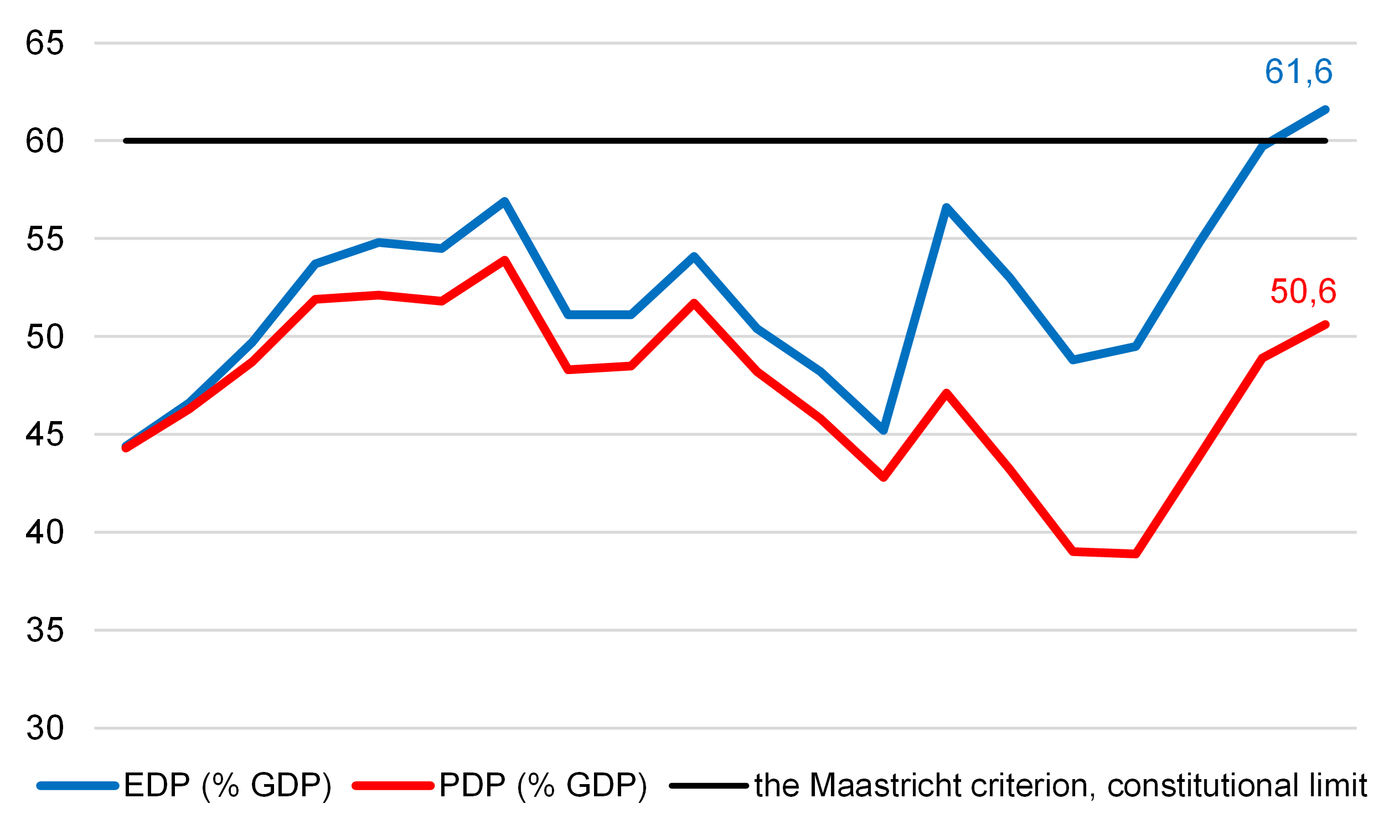
Source: Ministerstwo Finansów (2026).
Note: EDP debt (Maastricht debt) – gross consolidated general government debt according to EU methodology (the Maastricht definition), covering central government, local government and social security funds. PDP debt – public debt as defined under Polish national law (the Public Finance Act), covering a narrower range of institutions than EDP debt.
As has gradually become clear in Poland, rules alone are not enough. In addition to the constitutional debt limit (60 per cent of GDP), the Polish fiscal framework also includes statutory debt thresholds (progi ostrożnościowe) and a stabilising expenditure rule (stabilizująca reguła wydatkowa), including its correction mechanism. The debt thresholds are based on the national definition of public debt (PDP); if a threshold is breached, statutory preventive or corrective measures are automatically triggered. At present, the only remaining threshold is 55 per cent of GDP in PDP terms. Previously, there was also a 50 per cent threshold, but this was removed by an amendment to the Public Finance Act (Ustawa o finansach publicznych), which came into force at the start of this year. One might ask whether this was because it would otherwise have had to be activated. The expenditure rule operates countercyclically (it is linked to medium-term potential output growth and inflation), an important feature for the practical conduct of fiscal policy. In my view, the problem with Poland’s public finances in recent years has not been so much a lack of rules as the shifting of some expenditure outside the state budget, which has weakened national fiscal rules. But let us return to the recent history of the Fiscal Council’s establishment.
While most EU Member States established fiscal councils or similar bodies in the wake of the European debt crisis, Poland chose to rely on its existing institutional arrangements. Expert assessment of fiscal policy was spread across several public institutions, none of which met the criteria for an independent fiscal council under European standards. The European Commission, the OECD and other international institutions repeatedly pointed out that fiscal rules alone may not be sufficient to ensure sustainable public finances. History has shown that rules can be amended, circumvented or interpreted in ways that weaken their original purpose. An independent fiscal institution is therefore not a rival to fiscal rules, but their natural complement and guardian. This was eventually recognised by Polish lawmakers as well. Things began to move at the start of this decade, and the COVID-19 pandemic, with the additional pressure it placed on public finances, further intensified the debate on independent fiscal oversight in Poland.
The establishment of the Polish Fiscal Council marks a significant milestone not only for Poland, but also for the European Union as a whole. The Fiscal Council was formally established and began operating on 1 January 2026. It was established under the Act of 20 December 2024 on the Fiscal Council. Six of its seven members were confirmed by the Senate on 9 December last year following an earlier vote in the Sejm. The Council’s members are nominated by: (i) the President of the Republic of Poland (seat currently vacant), (ii) the Ministry of Finance (whose nominee serves as Chair of the Council), (iii) the President of the Supreme Audit Office (Najwyższa Izba Kontroli), (iv) the Conference of Rectors of Academic Schools in Poland (Konferencja Rektorów Akademickich Szkół Polskich), (v) the Social Dialogue Council (Rada Dialogu Społecznego) representing employees, (vi) the Social Dialogue Council representing employers, and (vii) the Joint Commission of the Government and Local Government (Komisja Wspólna Rządu i Samorządu Terytorialnego). It is worth noting that candidates were selected through a public call for applications. A shortlist of two to three candidates who met the criteria was drawn up and submitted to the Marshal of the Sejm. The candidates then appeared at public hearings before a parliamentary committee, where their qualifications, independence and experience were assessed. The Sejm, with the consent of the Senate, then appointed the members of the Fiscal Council. The Polish Fiscal Council has a remit similar to that of other IFIs in Europe: it provides independent assessments of fiscal policy, monitors compliance with fiscal rules, evaluates macroeconomic and budgetary forecasts, and highlights long-term risks to public finances. The establishment of the Fiscal Council can also be seen as symbolically completing one stage of European fiscal integration.
Poland faces fiscal challenges similar to those elsewhere in Europe. The establishment of the Fiscal Council comes at a time when Poland’s public finances face a growing number of long-term challenges. Although Poland has experienced relatively rapid economic growth over the past two decades and for many years maintained a lower debt ratio than many Western European countries, the outlook for the coming decade is less favourable. One key factor is adverse demographic developments. Like other European countries, Poland will face rapid population ageing. This will put increasing pressure on the pension system, healthcare and long-term care. At the same time, the country is significantly increasing defence spending, which is already the highest in NATO as a share of GDP. Further fiscal pressures stem from the need to modernise the energy sector and transport infrastructure, as well as from the ongoing technological transformation of the economy. Poland’s fiscal policy should also ensure that failure to meet the Maastricht fiscal criteria does not jeopardise its path to euro area membership. Regardless of the country’s timetable for adopting the euro, however, sound and sustainable public finances are just as important as price and financial stability.
Poland’s experience in recent years offers important lessons for public finances in the Czech Republic today. In my view, extensive use of exemptions and escape clauses, mislabelling expenditure (for example, classifying defence expenditure as non-defence spending), excluding some expenditure from the debt measure, or increasing deficits during an economic upswing (procyclical fiscal policy) will not improve the health of public finances. Above all, we should bear in mind the uncomfortable truth that every debt must ultimately be repaid!